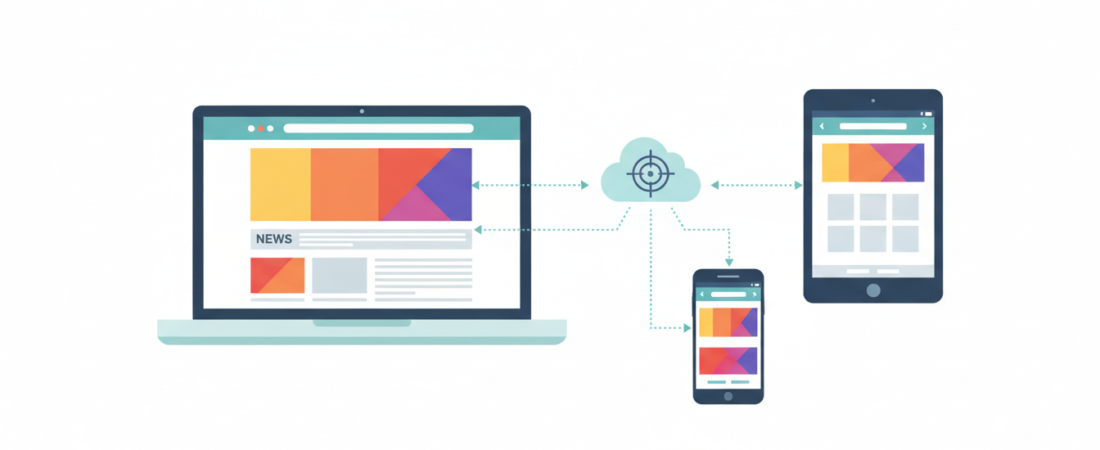
Search ads reach people who are already looking for something. Display advertising works differently: it puts visual ads in front of people while they read articles, watch videos, check email, or use apps. That makes display a powerful way to build awareness and bring back past visitors, but it also makes targeting and measurement more important, because the audience is not actively searching.
What Is Programmatic Advertising?
Programmatic advertising is the automated buying and selling of ad space using software instead of manual negotiation. When a webpage loads, the available ad space can be sold in a real-time auction, called real-time bidding (RTB), that finishes in milliseconds. Several systems make this possible:
- Demand-side platform (DSP): software advertisers use to buy ad impressions across many websites and apps. Google’s DSP is Display & Video 360.
- Supply-side platform (SSP): software publishers use to sell their available ad space.
- Ad exchange: the marketplace where DSPs and SSPs meet and auctions take place.
Not all programmatic buying is an open auction. In a private marketplace, a publisher invites selected advertisers to bid on premium inventory. In programmatic guaranteed deals, an advertiser reserves a fixed number of impressions at an agreed price.
The Google Display Network
Most small businesses buy display ads through Google Ads, which places ads across the Google Display Network: millions of websites and apps, plus Google properties like YouTube and Gmail. Display campaigns use responsive display ads, where the advertiser uploads headlines, descriptions, images, and logos, and Google automatically assembles them to fit almost any ad space.
Programmatic Targeting for Relevant Traffic
Targeting decides who sees the ads, and it is the biggest factor in whether display traffic is valuable or wasted. The main options are:
- Contextual targeting: showing ads on pages about related topics or keywords, like a running shoe ad on a marathon training article.
- Placement targeting: choosing specific websites, apps, or YouTube channels.
- Audience segments: affinity audiences based on long-term interests, in-market audiences who are actively researching a purchase, and custom segments built from keywords or websites.
- Your data (remarketing): showing ads to people who already visited the website or used the app.
- Demographics and location: limiting ads by age range, household type, or geographic area.
Here is how a local business might combine them. A Dearborn furniture store could target an in-market audience for home furnishings, limit ads to a 15-mile radius, and run a separate remarketing campaign for visitors who viewed a sofa page but did not buy. Layering targeting this way keeps the budget focused on people likely to become customers.
How Display Ads Are Priced
Display ads are commonly priced by cost per thousand impressions (CPM). Google Ads also uses viewable CPM (vCPM), which charges only for impressions that were actually viewable. By the Media Rating Council’s standard, a display ad counts as viewable when at least 50% of it is on screen for at least one continuous second. Advertisers focused on results can also bid for clicks or conversions instead of impressions.
Brand Safety and Frequency
Because ads can appear on thousands of sites, advertisers need to control where they show up. Content exclusions and placement exclusions keep ads away from inappropriate or low-quality pages, and placement reports show exactly where ads ran. Frequency capping limits how many times one person sees the same ad. Without a cap, a remarketing campaign can show the same ad so often that it annoys people instead of persuading them.
Measuring Display Campaigns
The right metrics depend on the goal. Awareness campaigns focus on reach, frequency, impressions, and viewability. Performance campaigns focus on conversions, cost per acquisition, and return on ad spend. View-through conversions, which count people who saw an ad without clicking and converted later, should be reviewed carefully, since some of those people would have converted anyway.
Privacy changes have also made first-party data more important. Customer lists, website visitors, and email subscribers that a business collects with permission are more reliable for targeting than data from outside sources.
Key Takeaways
Display and programmatic advertising can reach people long before they search, but success depends on precise targeting, brand safety controls, sensible frequency caps, and measurement tied to real business goals. Display works best alongside keyword research and search campaigns: display builds awareness, and search captures the demand that awareness creates. AI can also speed up display campaign work, as I cover in AI techniques for Michigan marketers.
References
- Google Ads Help, “About Display ads and the Google Display Network”
- Google Ads Help, “About audience segments”
- Display & Video 360 Help Center
- Media Rating Council, viewable ad impression measurement guidelines
AI disclosure: AI was used to help research, organize, and draft this post.